
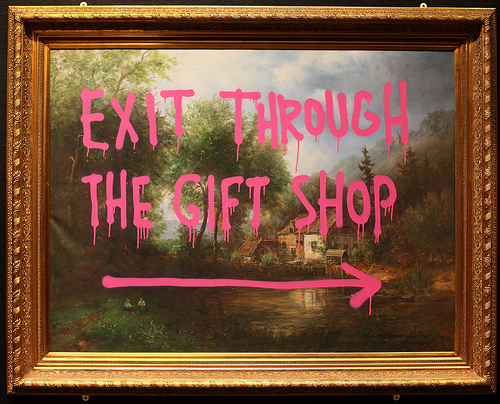
Banksy always struck me as a bit of a tool, one of those pseudo-post-modern artists who got it, and then continually shoved in your face just how much of it they got, and how much you owe them for exposing you to it, whatever it is. Chuck Palahniuk, as good of a writer he is, does this; making it nearly impossible for me to read his novels without any sort of cynicism about his, well, cynicism. The Coen brothers rub me the same way. That sort of thing, if you know what I'm talking about. And if you don't, sorry. I suppose I get it. Shame on your for being the plebe who doesn't.
My premiere exposure to Banksy was in my first year of college. It was one of those things people discover in their first year of college, like the Boondock Saints or Marxism or that picture of Che Guevera. A friend of mine showed him to me, and I was more or less impressed; not just because someone had been able to place graffiti throughout London (people have been doing that for centuries), but that it was pretty damn clever and aesthetically fantastic. When he plastered art all over the Gaza strip, I applauded the effort. Banksy's work--and the street art that began cropping up in various places at the beginning of the 21st century--seemed to have a noble, if playful cause: to turn walls and streets into art, not art that was sanctioned and planned out by the city, but by a few shadowy artists who could, with a simple poster or stencil, make people look up from their shitty jobs, their daily commutes, and see something that added beauty and strangeness to a world that was so usual it had become invisible.
But street art became, like most decent movements, ruined by those who followed it; the many that became pretentious enough to annoy the people who liked it and turn away those who didn't yet understand. There were, in short, way too many douchebags who liked to prominently display a Banksy book or poster in their living room. Banksy, not yet having an identity other than some bloke who put up clever paintings next to famous paintings, became an extension of that not-really-smart-but-still-pretentious douchebag personality that I despised so much. Suffice it to say, me and any interest in Banksy fell out of touch, and I haven't really had any inclination to call it back.
So on Sunday, when my friend Beth asked if I wanted to see Exit Through The Gift Shop, the "Banksy movie" (as I had heard it called, because really, that was the only draw about it), I was mildly interested. We saw it at the Larelhurst, where in proper Portland tradition, you can sit down with a cool pint of beer, a slice of pizza, and watch a matinee for $3 (beer and pizza not included). Being short on cash, I sat down with my PBR and propped my feet on the table in front of me. After previews for The Girl With The Dragon Tattoo and The Girl Who Played With Fire (the former of which I saw, and loved, and the second I have yet to see, though the book proved more lackluster than the first so I don't have great expectations), the film began, and almost immediately my cynicism subsided and I became awash in a very, very good film. And I don't use that term often.
Exit Through The Gift Shop does not, as one may suspect, follow Banksy on his famous exploits about London. Instead it focuses on Thierry Guetta, a French Ex-Pat living in Los Angeles, where he owns and runs a vintage store in one of LA's more "bohemian neighborhoods" (Gift Shop is narrated, by the way, by Rhys Ifans, who narrates with a clever brogue, a tone which hops flawlessly between serious and mock-serious, admirable narration skills if I ever heard 'em). When we first meet Thierry and he explains his job, he casually describes how he would take, from literally tons of bags of used clothing, any number of items and mark up the price to what he saw fit: "If the stitching is a little different," for example, "I label it 'designer.'" Thierry himself seems to be a harmless, bumbling frenchman of the best sort (when Banksy most openly mocks him, it is with an accompaniment of jovial accordion music, as one who has never been to Paris thinks every corner of Paris sounds like). He has a potbelly, a large mutton-chop and mustache combination, and wears a fedora with more gusto than Justin Timberlake in 2007. He has a wife and children, who he loves. He also has an obsession: he carries a video camera with him everywhere he goes. He saves the footage, too, in dozens of boxes upon boxes, never meaning to watch the tapes.
It is on one of his trips to France that Thierry begins to spend more time with his cousin, who turns out to be Space Invader, a street artist that was gaining some renown. Space Invader's art is, as his name suggests, mostly mosaics that replicate old 8-bit video game characters, which he pastes to walls or wherever he can fit them. Through his adventures with Space Invader, Thierry is introduced to the world of street art, meeting several artists and passionately filming their every move: as they climb billboards and plaster posters onto buildings, when they get arrested or barely avoid the police, and even when they head to Kinko's to print our another 10x10 that will, under cover of dark, become a semi-permanent front of some edifice, somewhere. Thierry's footage captures an exhilarating practice, turning what was just graffiti into an athletic and fully human undertaking: I could feel my hands itching to tag something, to stencil an unforgettable image onto a storefront. You really do have to admire these guys, to put up art at the risk of arrest, with no profit in sight, only the hope of getting a little immortality out of it. And, of course, they can go by that corner every day, look up at that billboard, and be reminded that they changed the way it looked, even when their work is eventually painted over with something mundane.
Banksy, of course, is the golden egg of all these gents. A coyote-like trickster lurking in the streets of London, Banksy is impossible to come in contact with, despite how much Thierry--and, of course, much of the British media--would like to. Banksy eventually travels to Los Angeles, where Thierry finds him and shows him around, watching the artist work, filming it--of course--even as Banksy opens an art show in LA, which brings street art to the forefront of popular culture. Banksy's art and the work of others like him is showing up in auction houses all of a sudden, even though as Banksy himself protests: "it was never about the money." (take that phrase as you will, as it is doubtless that Banksy isn't short on fame or fortune at this point in his subversive career) A trip inside one of the art collector's homes reveals a horrifying side of the practice: the collector takes us on a tour of a house wallpapered with framed originals, she motions to the paintings with the passion of someone pointing out long-forgotten classmates in a yearbook they don't care about. She motions to a fantastic Pop-Art piece and her only remark about it is "that's a Lichtenstein." A minute later she admits that the first piece she bought, a Picasso, is in a closet, and she can barely remember which closet it's in.
Thierry follows Banksy to London, where he observes more of Banksy's undertakings, visits his studio, and becomes, to Banksy, "a sort of friend." Thierry edits together the hours upon hours of footage he has taken of street artists, and the result is disastrous, a hideous collage or film-school sensory stimulation. Hoping to soften his critique of his friend's horrible film, Banksy encourages him to return to LA and make his own art. And that is when the delightful jaunt through the world of street art takes a sharp left.
Thierry adopts the name "Mister Brain Wash," a monicker that he uses to solidify for himself a new persona in the world of Street Art: not as the fly-on-the-wall cameraman, but as an active participant. But while most artists need years to perfect their skill and hone in on the right style for their personality, Thierry cuts the line significantly, throwing all of his funds into opening a studio where he employs dozens of artists to flesh out his ideas, one assistant calmly explains how they take an image and then photoshop it to Mister Brain Wash's specifications. Another picks up a book of art and indicates the multiple sticky notes that MBW has filled it with. It's a shallow and over-done mockery of Andy Warhol's factory, which was a mom and pop corner art production space compared to the assembly plant that Thierry has concocted.
The art that is produced isn't terrible, and it's almost original, if you've never seen any sort of Pop Art from the past fifty years. Elvis wields an AK-47 instead of a guitar. A spray paint can is made to look like Warhol's Campbell's Soup can. Warhol seems to be haunting Thierry's ideas, as he replicates Warhol's Marilyn Monroe screen print with the faces of different celebrities: Obama. Spock. Hillary Cliton. Condoleeza Rice. It's Pop Art of Pop Art. George Washington wears wayfarer sunglasses. Winston Churchill wears wayfarer sunglasses. Stormtroopers fight in the civil war. Spock wears wayfarer sunglasses. American Gothic is repainted, but the farmer and his wife carry spray cans. You can almost see Mister Brain Wash dictating the plans for his pieces, the concepts are so terribly obvious. In my own opinion, without a doubt, it's not very good art. There were a few times when I leaned in Beth's ear and whispered "But it's so shitty."
And then, once he had pushed his image onto the public of Los Angeles, MBW buys out a dilapidated building, guts it, and fills it with more art than any single art show should rightfully hold. And the public, not knowing whether this artist is legitimate or fraudulent, arrive by the thousands. And they, for the most part, eat it up, and several of them buy MBW originals, totaling in over $1,000,000 in art sales on a single night. At first, you wonder: how can someone so dedicated to being in the world of street art sell out so readily? And then you remember: this is the guy who sold $10 shirts in a vintage shop for $75.
Of the many conversations about art that Exit Through The Gift Shop sparks, one of the more obvious ones is that age-old query of what art is. How do you identify art? What is the purpose of it? In the world of street art, the most important thing to remember is that it is temporary art in its true form. An OBEY poster will fade, or be torn down, or covered. Even Banksy's celebrated original stencils littering the walls of London are unprotected by anyone or anything. It's quick, it's free, it's fun--even when, as evidenced by Banksy's Guantanamo Bay-inspired installation at Disneyland, there is a distinct element of commentary. And yet, even art that has no intrinsic value still has some sort of sentimental wealth to it. As much as Banksy seems to be a trickster, a shadowy figure who paints on walls just to mess with people, one look in his studio and you realize just how much he loves his creative process. Space Invader, when asked if street art was his profession, simply replies, "C'est ma passion." The work of MBW seems more than just a cheap knock-off, it comes across as outright stealing, a way for the bumbling, half-mad Frenchman to achieve his own moment in the spotlight. It is worse than selling out: it is creating the product strictly for the purpose of selling out. In Thierry I saw all the so-called hipsters who are following a movement, every art student who has an uncanny way of picking up on trends at just the right time so that they can look creative without having to actually be creative. Ironically, these are the personalities that turned me off to Banksy in the first place. Though the documentary does, in the end, come down heavily against Thierry's success as MBW, a bias that seemed a bit too obvious, it's hard not to be depressed by the guy's development into international art star within a few months. It is as though Banksy is using the last third of the film to lecture those who must, in their day-to-day lives, decipher between art done for the sake of art and art done for the sake of money. The moral, then, might simply be this: that art, even when it is not permanently hung in a gallery or in a private collection, is invaluable. And at the same time, art that is made for the sake of value is worthless.

No comments:
Post a Comment